Film review
Paperman2012
John Kahrs
Contains spoilers about Paperman (2012), Mary and Max (2009), Blow Out (1981), The Departed (2006)
When I was about 7 or 8 years old, a family friend showed me the movie Mary and Max (2009). I think they thought it was an animated film, so obviously, it would be a kid’s film. Or maybe they genuinely saw the movie and felt like I would like it. In a nutshell, the movie is about two pen pals, a little girl from Australia (Mary) and a middle-aged man from New York (Max). It’s a heavy movie. Its emotional, and deals with themes of loneliness, mental illness, friendship, suicide, depression, isolation and many more.
So naturally, little me hated that movie. At the time I thought it was terrible and had the worst ending (spoiler: Max dies). I blocked it from my memory for many years to come. But recently, I seemed to remember parts of it again and decided to give it a watch again. This time around, however, I loved the movie. It understands loneliness without romanticizing it and portrays friendship as something imperfect.
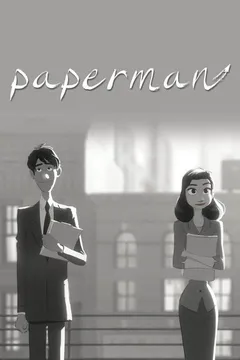
But this report is not about Mary and Max. It is about Paperman (2012). Paperman is a Disney animated 7 minute short directed by John Kahrs. It follows the events of a day in which the main character falls in love to the extent that he walks out of his job to pursue a girl that he doesn’t even know about.
There’s no dialogue. The story is told only through visuals, expressions and Christophe Beck’s score. The movie is made in a hybrid style which consists of hand drawn lines layered over computer generated animation. This is why it looks like a classic 2D Disney film but movies like 3D. It was made to play before Wreck-It Ralph and won the Oscar for Best Animated Short.
If the novel’s strong suit is the display of the passage of time over generations (Steinbeck’s East of Eden for example), then I would say the film’s strong suit is conveying information without explicitly having to spell it out. Of course, some works borrow the other medium’s strengths brilliantly. My point being: Paperman, as a film, is a wonderful example of visual storytelling.
The short is black and white. It starts off with a guy carrying some papers, when they get blown off and land on the face of a woman, whose red lipstick stain gets on the paper (the only other color in the film). Making the lipstick the only color in the film tells us that in his routine monotone life, she’s the only one that stands out.
The woman leaves abruptly before the man can talk to her about anything. But, that short encounter is enough to make the man besotted with her. Even after reaching work, he cannot stop thinking about her and by some coincidence, she works in the building opposite to his.
He tries everything he can to get her attention, but to no avail. The man then makes paper airplanes and throws them at her window. But even that doesn’t work. At the end, he is only left with the lipstick-stained-paper, and he is forced to throw it in a last-ditch attempt. After even that fails, he is left dejected and leaves his workplace.
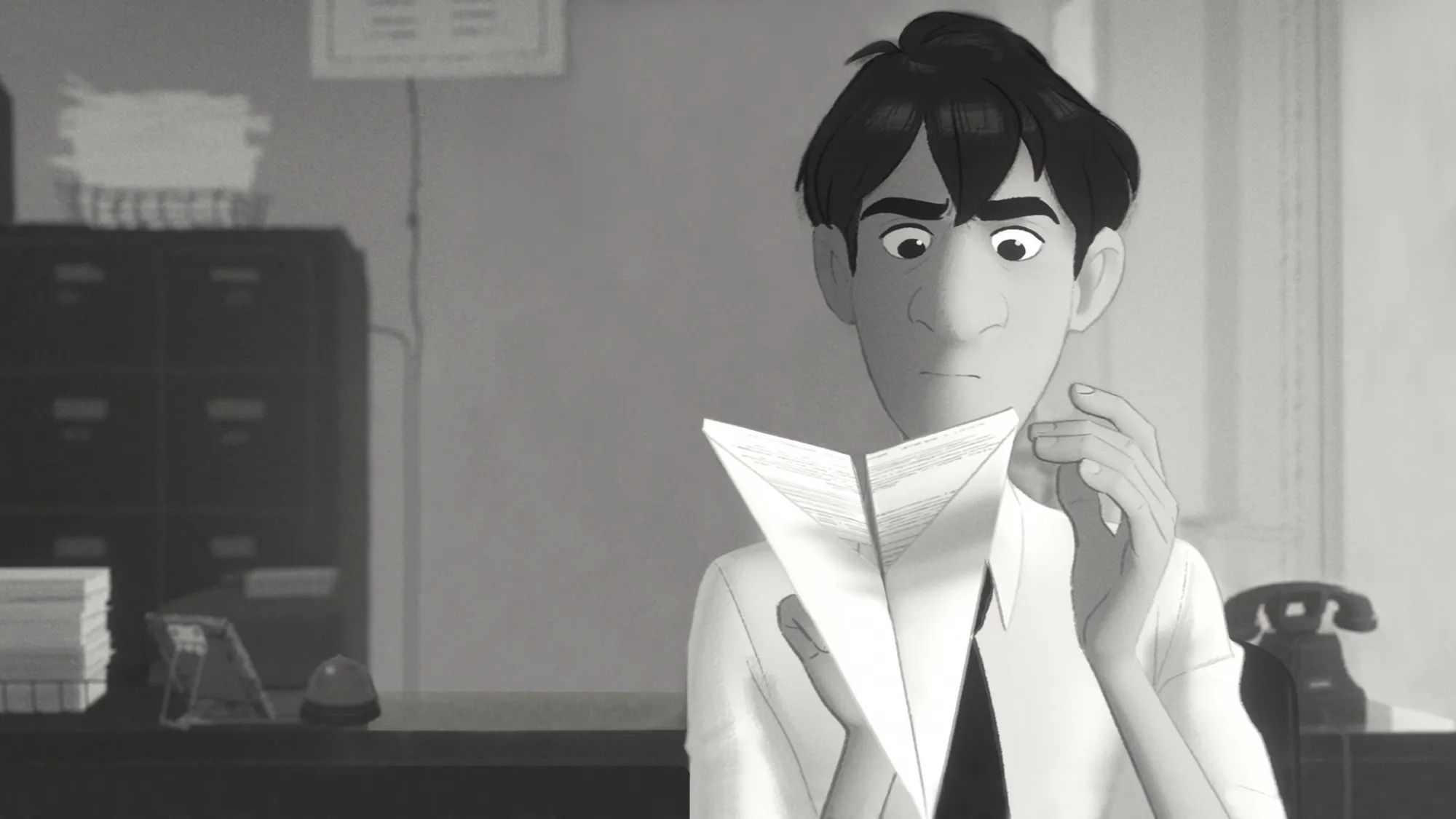 Out of options, he starts folding.
Just as he has given up all hope, all the thrown paper airplanes seem to come to life, and now they try to get the man and the woman to meet. The woman willingly follows an airplane while the man has to be forced to follow them. After everything, they meet each other face to face and the short ends. The film lets him fail completely before the magic happens. Maybe the point is that connection isn’t something you can force. Sometimes, it finds you once you stop trying.
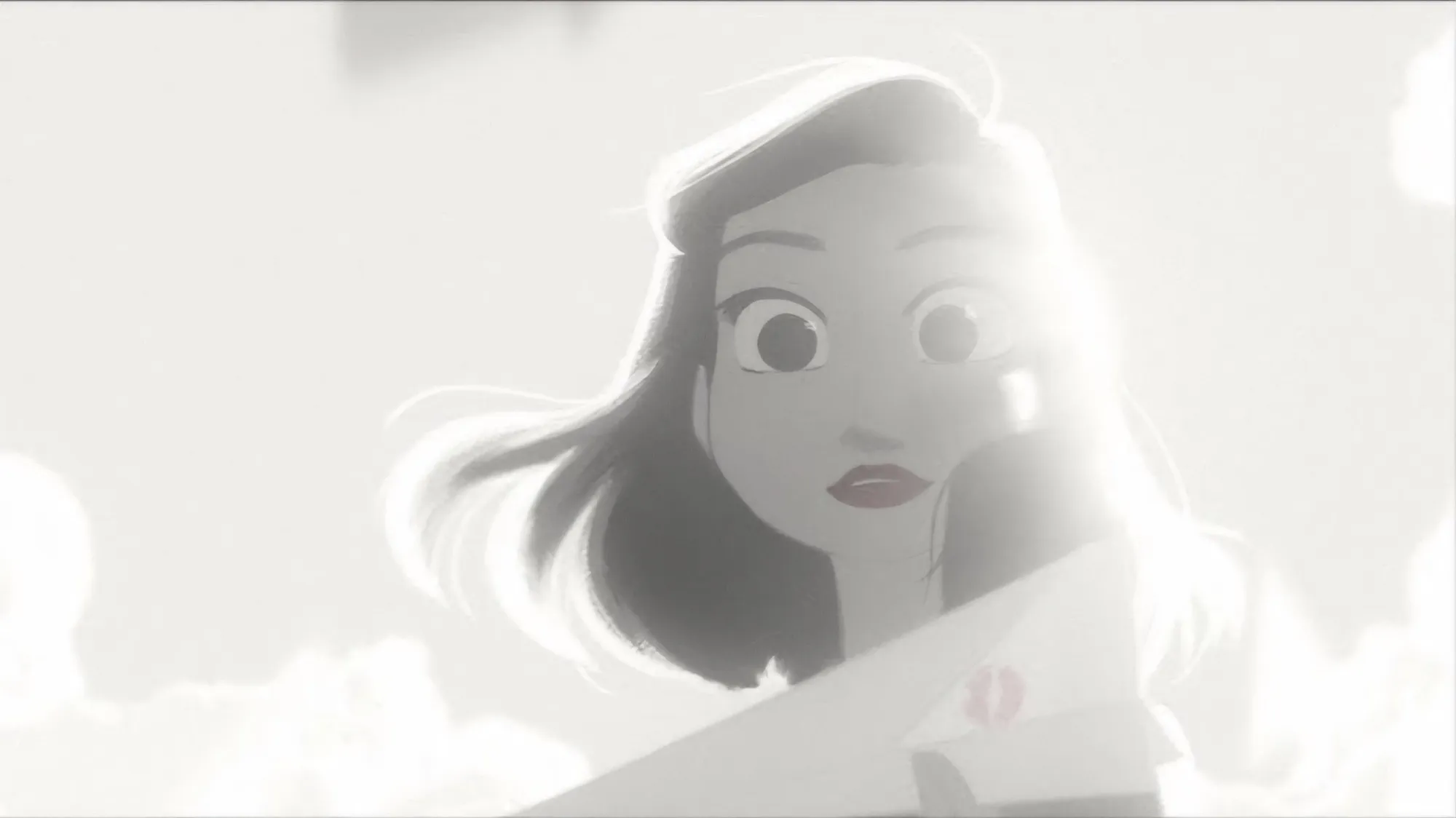 The lipstick mark, still the only color in the frame.
What a heartwarming and beautiful story! The beauty of its narrative lies in its simplicity. It is almost completely contrasting the layered, heavy and serious themes of Mary and Max. So why did I start off with talking about that movie? The reason being, both films explore human connection. In Mary and Max, connection is slow, awkward, and imperfect. It develops through years of letters, misunderstandings, and emotional vulnerability. In Paperman, connection begins with a fleeting encounter. The story transforms attraction and coincidence into something almost magical.
Both films use a similar color scheme, and are interested in the human desire to find someone who makes an otherwise lonely world feel less lonely. But they approach that desire from opposite directions: one through the messiness of real relationships, the other through the optimism of romantic fantasy. Mary and Max never actually meet. Mary arrives just after Max has died. Paperman’s whole story leads up to the meeting and ends the moment it happens.
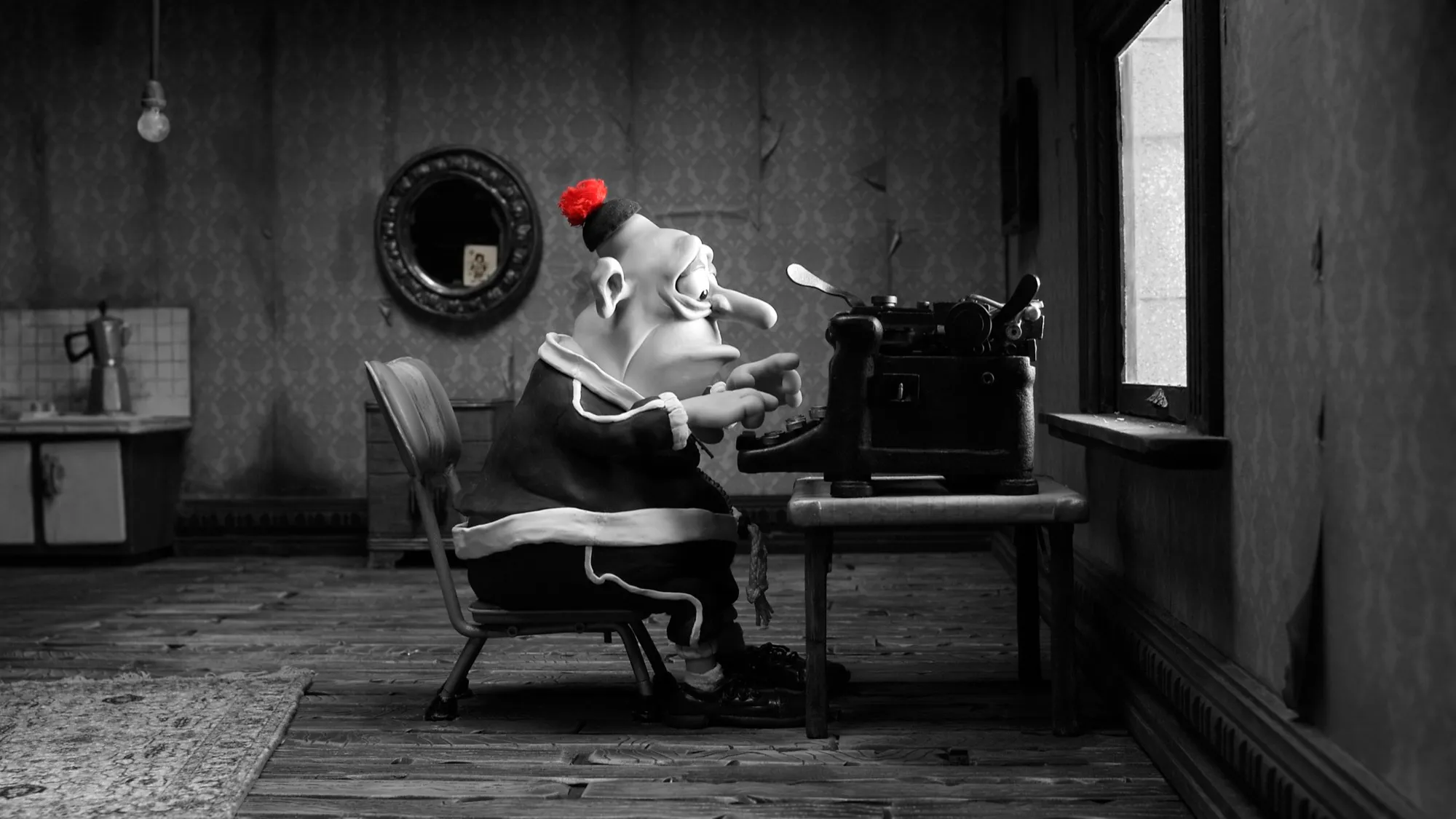 Mary and Max: the same grey world, with a single touch of red.
This brings me to another point, human beings’ innate desire for happy endings. I remember watching Blow Out for the first time and wanting to kill de Palma myself after finishing the movie. Or watching The Departed and having to stare into a wall for a full 5 minutes as Roy Buchanan’s Sweet Dreams plays over the credits. This exact desire for a happy ending is what made younger me hate Mary and Max. Yet, Paperman doesn’t have a conventional “happily ever after” ending either.
So, what makes a good ending? In my opinion, its either closure, catharsis, or cliffhangers. And a cliffhanger ending suits a movie like Paperman so well because it is a fantasy. (Cliffhanger is a strong word; I mean like an open ending.) Being a fantasy is part of its appeal, not a bad thing. The movie imagines a universe that rewards persistence and wants lonely people to find each other. Mary and Max shows a world that isn’t that kind and where connection takes effort and still costs something.
There is a small group of cinema purists that will dismiss a movie like Paperman as being ‘for the masses’ while regarding Mary and Max as ‘high art’. They couldn’t be further from the truth. Both movies are beautiful in their own right, and ranking them would be pointless. What is permissible, however, is analyzing them side by side and drawing conclusions based on that analysis.
My conclusion would be the answer to a simple question. Would 7-year-old me have loved Paperman? Absolutely. It gives a child exactly what they want. Two lonely people, a little magic and a meeting at the end. Mary and Max tells us what connection actually costs, while Paperman reminds us of why we keep reaching for it anyway.
It’s fitting that both stories are carried on paper. Mary and Max hold on to each other through years of letters, while Paperman sends his feelings across a street, one paper airplane at a time. One shows that paper can carry a friendship across the world even if two people never meet. The other imagines that, if we through enough of it, the world might just carry us the rest of the way.